
Ankle Sprains in Adolescent Athletes: When Should We Be Concerned?

هذا المقال متاح باللغة الإنجليزية فقط.

The ankle is one of the joints most frequently injured during sports activities. Football, basketball, handball, volleyball, hockey and athletics are among the sports in which adolescents commonly sustain ankle sprains.
A misstep, sudden change of direction, jump or landing on another player’s foot can cause the ankle to twist.
In many cases, these injuries are mild and recover well. However, not all ankle sprains are the same, and some may involve underlying injuries that require further assessment.
1. What Happens When We Sustain an Ankle Sprain?
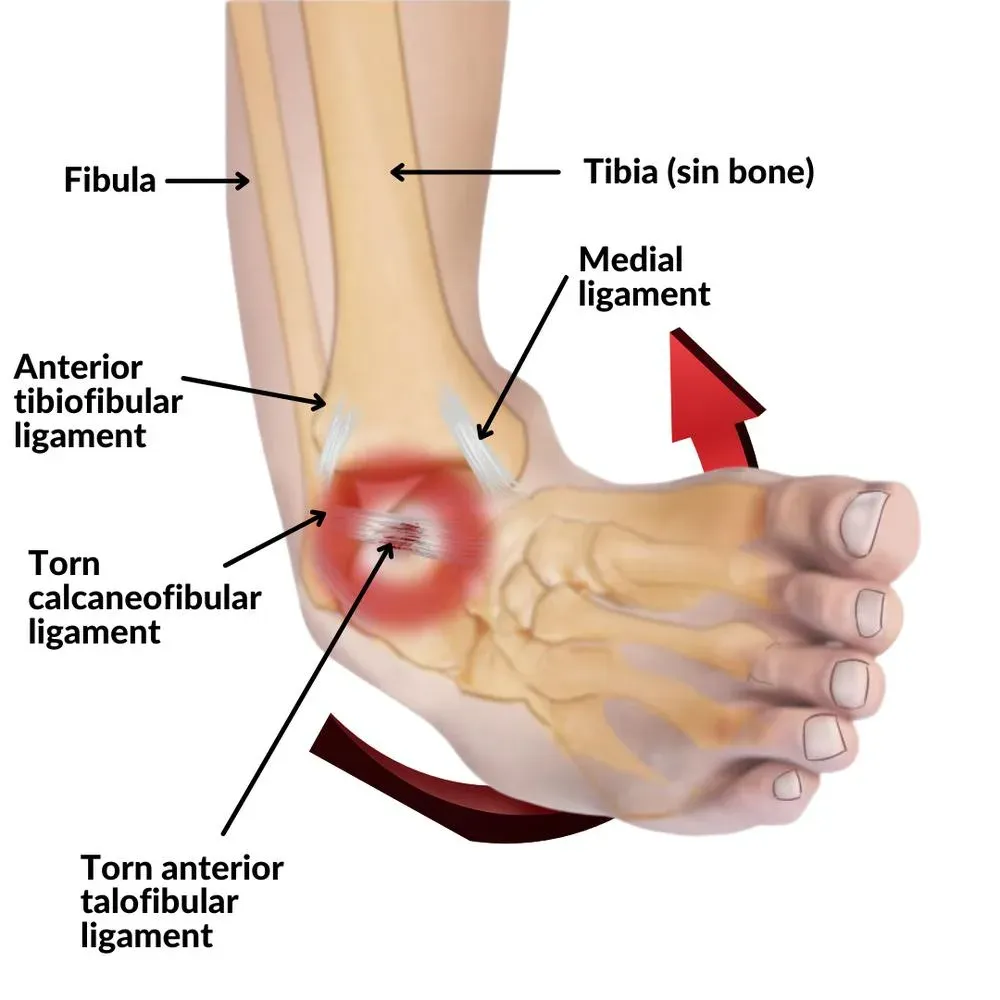
An ankle sprain is an injury to the ligaments that stabilise the joint. The most common mechanism is an inward twisting movement (inversion), which primarily affects the lateral ligaments.
The anterior talofibular ligament (ATFL) is the most frequently injured, followed by the calcaneofibular ligament (CFL).
Depending on the severity, ankle sprains are generally classified as:
-
Grade I: ligament stretching, with mild pain and swelling but no significant instability.
-
Grade II: partial ligament tear, with increased pain, swelling and difficulty walking.
-
Grade III: complete ligament rupture, which may result in significant ankle instability.
However, severity should not be determined solely by pain or swelling. Clinical examination is essential.
2. Why Should We Pay Special Attention to Adolescents?
During adolescence, the ankle may still have open growth plates or growth plates that are in the process of closing.
This is important because some injuries that initially appear to be simple sprains may actually involve the growth plate (physis), particularly at the distal fibula or tibia.
We should also consider other injuries that may accompany an ankle sprain:
-
Osteochondral lesions of the talus.
-
Syndesmotic injuries (high ankle sprains).
-
Peroneal tendon injuries.
-
Small avulsion fractures.
-
Physeal injuries.
For this reason, persistent pain in an adolescent athlete should not automatically be attributed to a simple ankle sprain.
3. When Should We Suspect Something More Than a Sprain?
Certain symptoms deserve particular attention:
-
Pain that does not improve after several weeks.
-
Persistent swelling following the injury.
-
A feeling that the ankle gives way or twists easily.
-
Deep pain inside the ankle joint.
-
Locking, clicking or a catching sensation.
-
Difficulty returning to running, jumping or changing direction.
-
Repeated sprains involving the same ankle.
In these situations, further imaging may be necessary.
X-rays help rule out fractures and assess bone structures. MRI may be indicated when an osteochondral, ligament or tendon injury is suspected, or when symptoms persist despite appropriate treatment.
4. Osteochondral Lesions of the Talus: An Injury That Can Go Unnoticed
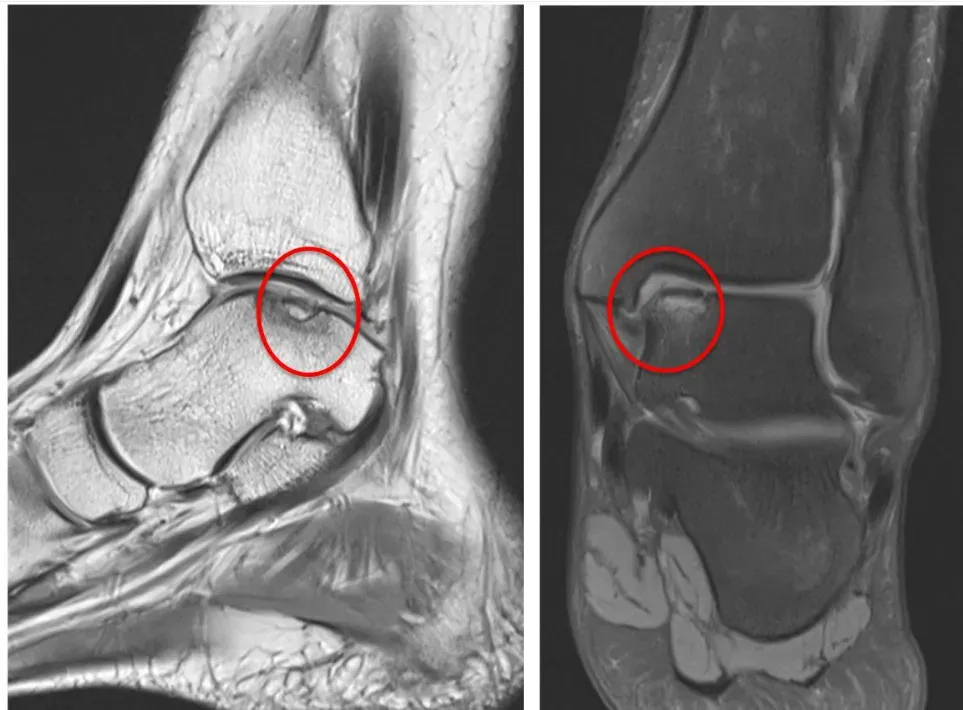
One of the injuries we should particularly consider following an ankle sprain is an osteochondral lesion of the talus (OLT).
The talus is the bone that forms part of the ankle joint and is covered by articular cartilage. During an injury, particularly when a twisting movement or significant impact occurs, damage may develop involving both the cartilage and the underlying subchondral bone.
These lesions may initially go unnoticed because their symptoms can resemble those of a conventional ankle sprain.
What symptoms may suggest an osteochondral lesion?
-
Deep ankle pain, particularly during sports activities.
-
Swelling that recurs after running or jumping.
-
Pain that persists for weeks after the sprain.
-
A sensation of locking or catching within the joint.
-
Difficulty returning to normal sporting activities.
In some patients, the ligament may have healed appropriately, yet the pain continues. In these cases, we should consider whether there is an associated injury to the articular cartilage.
How is it diagnosed?
X-rays may reveal some lesions, but they do not always show their full extent or severity.
MRI is particularly useful for assessing the cartilage, subchondral bone, bone marrow oedema and lesion stability.
In selected cases, CT can provide additional information about the bony involvement, the presence of subchondral cysts and the morphology of the defect.
What is the treatment?
Treatment depends on the location, size, depth and stability of the lesion, as well as the patient’s age and skeletal maturity.
Stable lesions with mild symptoms may initially be managed conservatively, with temporary modification of sporting activities and clinical and imaging follow-up.
When a lesion is symptomatic, unstable or fails to improve with conservative treatment, surgical management through ankle arthroscopy may be required.
Depending on the characteristics of the lesion, different techniques may be considered:
-
Debridement and removal of unstable fragments.
-
Drilling or bone marrow stimulation techniques in selected defects.
-
Fixation of osteochondral fragments when they are viable and can be preserved.
-
Cartilage repair or restoration techniques for more complex lesions.
The choice of technique must be individualised for each patient.
It is important to remember that persistent pain after an ankle sprain is not always caused by ligament damage. Sometimes, the problem lies in the articular cartilage of the talus.
5. How Should an Ankle Sprain Be Treated?
Treatment depends on the severity of the injury and the structures involved.
Most lateral ankle sprains can be managed conservatively.
During the first few days:
-
Protect the joint and temporarily reduce activities that cause pain.
-
Apply ice to relieve pain and swelling.
-
Use compression and elevate the affected limb.
-
Consider an ankle brace or functional support when indicated.
-
Gradually resume weight-bearing according to tolerance and injury severity.
More significant injuries may require a short period of immobilisation, tailored to the individual patient.
Rehabilitation is an essential part of treatment.
Waiting for the pain to disappear is not enough. It is important to restore:
-
Full ankle mobility.
-
Strength of the stabilising muscles, particularly the peroneal muscles.
-
Proprioception and balance.
-
Coordination and neuromuscular control.
-
The ability to run, jump and change direction.
6. When Can an Adolescent Return to Sport?
One of the most common mistakes is returning to training too early.
Being pain-free when walking does not necessarily mean that the ankle is ready for competitive sport.
Before returning to sport, the adolescent should have recovered:
-
Almost full ankle mobility.
-
Strength comparable to the uninjured side.
-
Good balance and single-leg control.
-
The ability to run, jump and change direction without pain or instability.
-
Confidence when performing sport-specific movements.
Return to sport should be gradual, progressing from individual exercises to sport-specific training and finally to competition.
7. Why Do Some Adolescents Experience Repeated Ankle Sprains?
When an adolescent sustains several sprains involving the same ankle, chronic ankle instability should be considered.
This may develop when the ligaments do not adequately recover their stabilising function after an injury.
Common symptoms include:
-
A feeling of insecurity when walking or running.
-
Recurrent episodes of the ankle giving way.
-
Difficulty performing jumps or changes of direction.
-
Pain or swelling after physical activity.
Initial treatment is usually based on rehabilitation, with particular emphasis on muscle strengthening and proprioceptive training.
If mechanical instability persists despite an appropriate rehabilitation programme, surgical ligament repair or reconstruction may need to be considered.
Final Thoughts
Ankle sprains are very common in adolescent athletes, but they should not be underestimated.
An apparently straightforward injury may lead to chronic instability or conceal an osteochondral, physeal or syndesmotic injury.
The goal is not simply for the adolescent to walk without pain, but to return to sport safely and without fear of reinjury.
Appropriate assessment, comprehensive rehabilitation and a gradual return to sporting activity are essential to protecting long-term ankle health.
المعلومات في هذا المقال إرشادية ولا تغني عن تقييم الطبيب المختص.