
Toe Walking in Children: Idiopathic or Neurological?

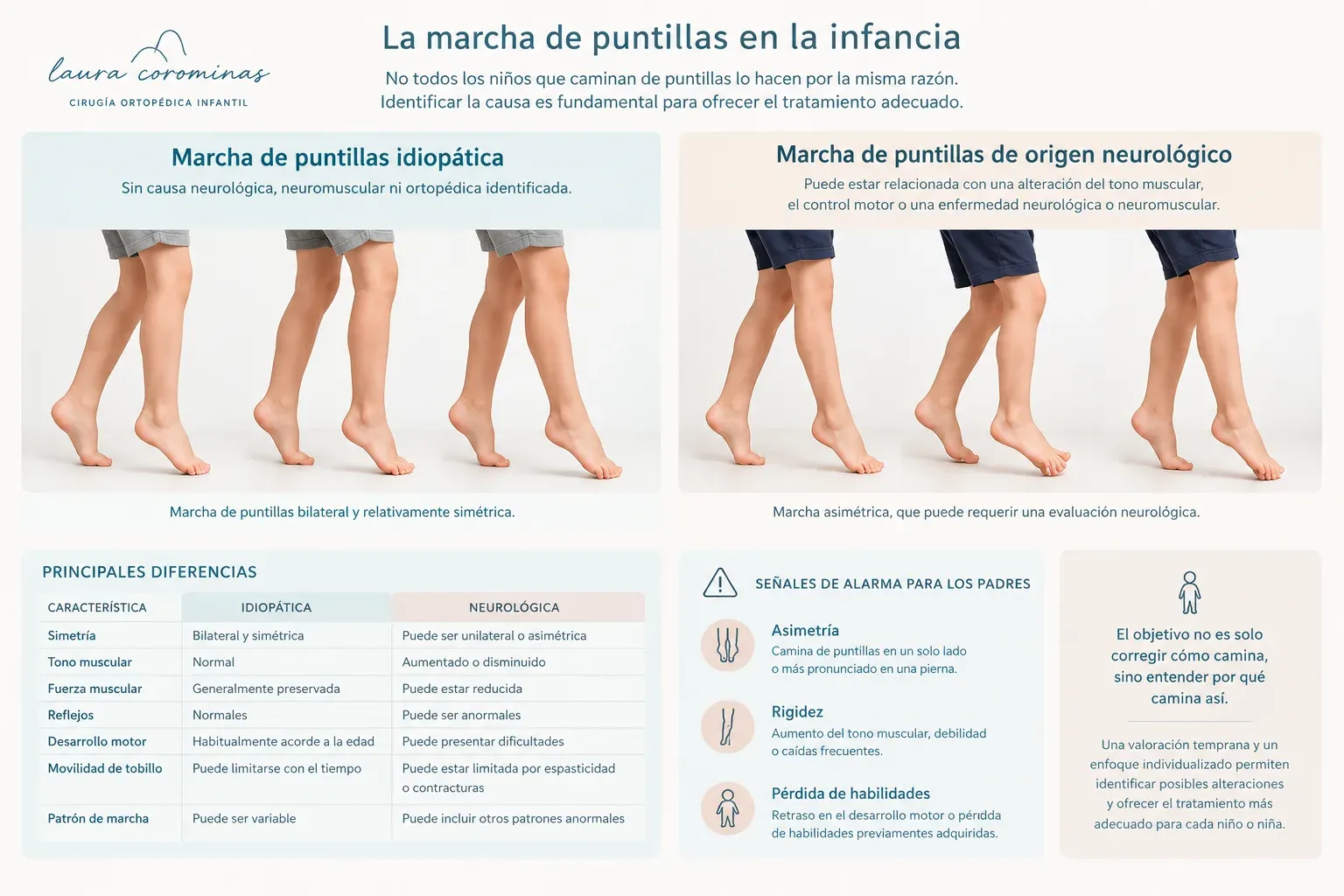
Although both patterns may look similar at first glance, there are clinical features that help us tell them apart.
1. Idiopathic toe walking
Idiopathic toe walking is defined as a persistent walking pattern in which the child walks mainly on the tips of their toes, with no identifiable neurological, neuromuscular or orthopaedic cause to explain it.
It is considered a diagnosis of exclusion, which means that other possible causes must be ruled out first.
The most common features are:
-
It usually affects both feet in a fairly symmetrical way.
-
The child may be able to put their heels down when asked to.
-
Muscle tone and strength are usually normal.
-
Motor development is usually appropriate for their age.
-
There are no other clear signs of a neurological problem.
-
A progressive limitation of ankle dorsiflexion (bending the foot upwards) may develop, especially when the pattern persists for years.
Some children alternate between walking on their toes and walking with the whole sole of the foot on the ground, while others keep this pattern almost constantly.
2. Toe walking associated with neurological conditions
Toe walking can also be a sign of an underlying neurological or neuromuscular condition.
In these cases, the walking pattern may be related to changes in muscle tone, difficulties with motor control, muscle weakness or abnormal movement patterns.
Some signs that may make us suspect a neurological cause are:
-
Asymmetry: it affects only one foot or is clearly more pronounced on one side.
-
Increased muscle tone: stiffness or spasticity in the legs.
-
Muscle weakness: difficulty controlling certain movements or maintaining a normal gait.
-
Abnormal reflexes: findings on neurological examination that suggest a problem with the nervous system.
-
Difficulties with motor development: delay in reaching motor milestones, problems with balance or coordination.
-
Difficulty putting the heels down: inability to voluntarily stand with the whole foot flat on the ground (plantigrade stance).
-
Developmental regression: loss of motor skills the child had already acquired.
Some conditions, such as cerebral palsy and certain neuromuscular disorders, can present with toe walking.
However, toe walking on its own is not enough to make a neurological diagnosis. The clinical findings need to be assessed as a whole.
3. What are the main differences?
FeatureIdiopathicNeurologicalSymmetryUsually bilateral and symmetricalMay be unilateral or asymmetricalMuscle toneUsually normalMay be increased or decreasedMuscle strengthUsually preservedMay be reducedReflexesUsually normalMay be abnormalMotor developmentUsually appropriate for ageThere may be difficultiesAnkle mobilityMay become progressively limitedMay be limited by spasticity or contracturesWalking patternMay be variableMay be associated with other abnormal movement patterns
These features are a guide and are not definitive diagnostic criteria. A full clinical examination is always necessary.
4. When should parents seek advice about toe walking?
Not all children who walk on their toes have an underlying condition. However, certain features should prompt a professional assessment.
It is advisable to seek advice when:
-
Toe walking persists beyond the first few years after the child starts walking.
-
The child walks on tiptoe with only one foot.
-
They cannot voluntarily put their heels down.
-
They show stiffness, weakness or frequent falls.
-
There are other problems with motor development.
-
Toe walking appears after a period in which they were walking normally.
A sudden change in walking pattern, especially if accompanied by weakness or loss of previously acquired skills, requires urgent medical assessment.
5. Why is early assessment important?
Identifying the cause of toe walking is essential to choose the most appropriate treatment.
In idiopathic toe walking, treatment may focus on maintaining ankle mobility, improving muscle flexibility and optimising walking mechanics. The options will depend on the child’s age, symptoms and degree of joint limitation.
When there is a neurological condition, treatment must address the underlying motor problem and the specific functional needs of each child.
Depending on the findings, the collaboration of a multidisciplinary team made up of paediatric orthopaedic surgeons, paediatric neurologists and physiotherapists may be needed.
The approach must always be individualised.
Final thoughts
Idiopathic toe walking and toe walking of neurological origin may look similar, but their mechanisms and treatments can be very different.
Assessing symmetry, muscle tone, strength, reflexes, ankle mobility and overall motor development helps us understand what is happening.
The goal is not simply to correct the way a child walks, but to understand why they walk that way.
Early assessment makes it possible to identify any underlying problems and offer the most appropriate treatment for each child.
This article is for general information and does not replace an assessment by a specialist.